
At a glance
Key points
- Fixed guards are preferred where routine access is not required.
- Interlocking stops hazardous movement when a guard opens.
- Guard locking keeps access closed while a hazard persists.
- Protective devices preserve open access but need sufficient stopping distance.
- Containment and reach prevention are different design duties.
1. Fixed guards
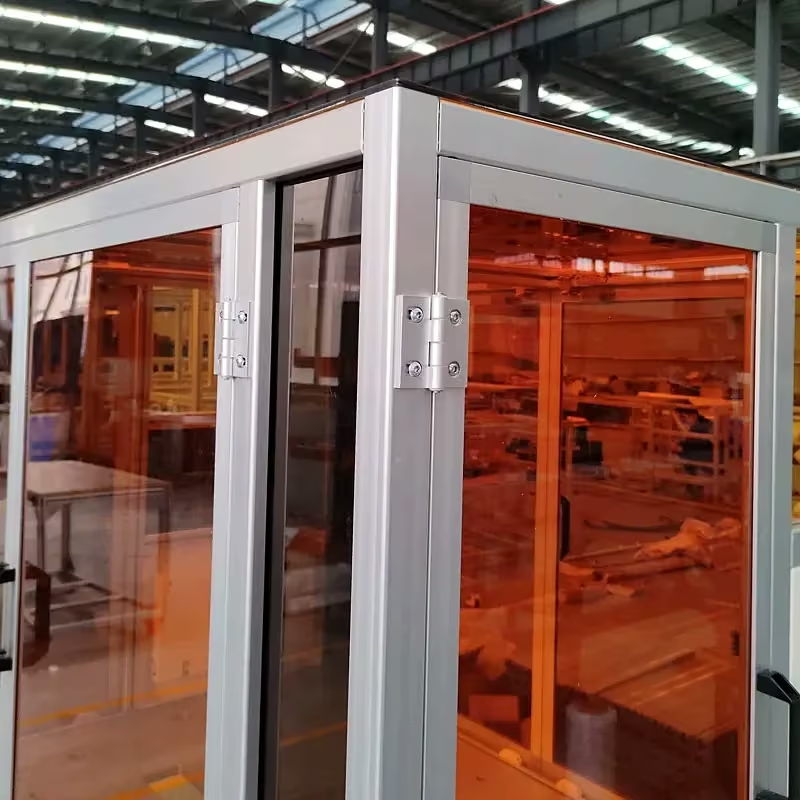
A fixed guard is retained so it can only be opened or removed with the intended method, normally using a tool. Examples include bolted covers over belts, mesh panels around a drive and tunnel guards around a conveyor nip. Fixed guards are simple and reliable when access is infrequent.
They become problematic when operators must remove them repeatedly for cleaning or adjustment. In that situation, a movable or interlocked solution may provide better real-world control.
2. Movable and interlocked guards
A movable guard opens without dismantling. Where opening could expose a hazard during operation, an interlock can initiate a stop and prevent operation while the guard remains open. The interlock should be difficult to defeat, correctly mounted and integrated into a suitable safety-related control function.
Interlocking does not automatically mean the hazard stops immediately. If run-down or stored energy remains, guard locking may be required.
3. Guard locking
Guard locking retains the door closed until release conditions are met. It is used where a person could reach the danger zone before hazardous motion, pressure, temperature or another risk has reduced. The system should define power-to-lock or power-to-unlock behaviour, escape, emergency release and loss-of-power response.
4. Adjustable and self-adjusting guards
Adjustable guards can be set to suit different workpieces or tool exposures, common on some workshop machines. Self-adjusting guards move according to the workpiece. Their effectiveness depends heavily on correct setting, condition and operator use, so they are not a default solution for every hazard.
5. Presence-sensing protective devices
Light curtains, scanners, mats and edges can detect approach or presence without a physical barrier. They are useful where frequent access or product flow makes a solid guard impractical. They require appropriate safety distance, field coverage, reset behaviour and stopping performance.
They do not contain ejected parts, noise, heat, dust, laser radiation or process material. Physical guarding may still be needed.
6. A selection matrix
| Safeguard | Best suited to | Watch for |
|---|---|---|
| Fixed guard | Infrequent access, simple reach prevention | Repeated removal, missing fasteners, openings |
| Interlocked guard | Regular access with rapid safe stop | Defeat, alignment, restart and stopping time |
| Guard-locked door | Hazard persists after stop demand | Escape, release logic, power loss |
| Light curtain | Frequent open access in a defined plane | Safety distance, reach-around, no containment |
| Laser scanner | Configurable floor or zone protection | Field coverage, standing zones, environment |
| Perimeter fencing | Large cells and automation | Transfer openings, hidden persons, reset |
Sources and review basis
Authoritative references
This guide summarises general engineering considerations. Current legislation, guidance and standard editions should be confirmed for the specific project.
How Oxford Machine Guarding can help
We can survey the equipment, define the mechanical guarding and safety-system scope, develop the design, supply and install the solution, and provide testing and handover records appropriate to the agreed project boundary.
Important: this guide provides general technical information. It is not a substitute for a machine-specific risk assessment, legal advice, or verification by the responsible dutyholder.
